
Cart
0
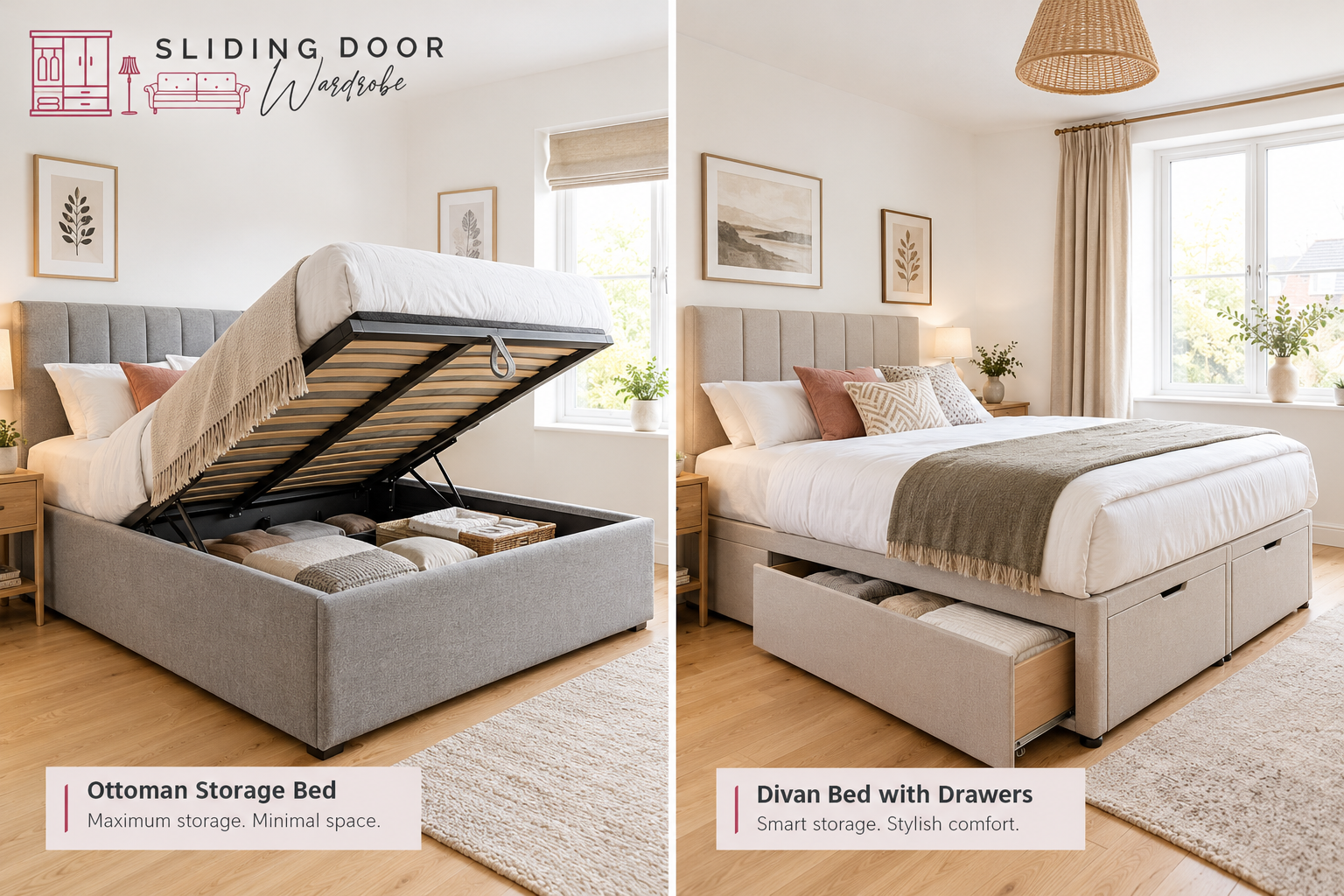
Storage is one of the most stubborn problems in UK bedrooms. The average British home has shrunk considerably over the past two decades, and bedroom square footage — particularly in flats, new builds, and terraced houses — is genuinely at a premium. Wardrobes fill one wall. Chests of drawers claim another corner. And yet somehow there is never quite enough space for everything a bedroom needs to hold.
The bed itself is the most underused storage opportunity in the room. It occupies more floor space than any other piece of furniture and for most of the day that space underneath it is doing nothing. Two bed types address this directly: the ottoman bed and the divan bed. Both store items beneath the mattress. But they work very differently, and the gap between them — in terms of how much they store, how you access it, and who each suits — is larger than most buyers expect.
How an Ottoman Bed Stores
An ottoman bed uses a gas-hydraulic lift mechanism built into the base. You lift the mattress from one end — typically the foot — and the entire base rises smoothly on the hydraulics, revealing a large, completely open storage cavity underneath. No compartments, no drawers, no separate sections dividing the space. Just one unobstructed area spanning the full footprint of the bed.
This is the defining advantage of the ottoman bed. Because the full width and length of the bed base is accessible in a single open space, you can store items that simply will not fit in any drawer — large suitcases, folded duvets, winter coats in vacuum bags, extra pillows, children's out-of-season toys, or anything else that tends to end up piled in corners or under the stairs.
The Rose Ottoman Grey Storage Bed takes this concept further with a double-compartment design — the storage space beneath is divided into two independent sections, each with its own gas-lift mechanism. For couples sharing a bed this is genuinely practical: each person has their own dedicated storage accessible from their side of the bed without disturbing the other. The solid wood frame is available in grey or light grey, includes an 11-inch thick mattress, and features a brick-pattern upholstered headboard that gives it a contemporary, considered appearance that works in modern and transitional bedrooms equally.
For those who prefer a high-gloss aesthetic, the Rugby White High Gloss Ottoman Bed offers LED-lit ottoman storage with a 40cm storage depth, easy-lift gas hydraulics, and a sleek MDF construction available in white or walnut finish — in double (W155cm x L215cm x H125cm) or king size (W165cm x L225cm x H125cm).
How a Divan Bed Stores
A divan bed is a fabric-covered solid base that sits directly on the floor, with storage accessed through drawers built into the sides. A standard two-drawer divan has one drawer on each side. A four-drawer configuration — the most common for storage-focused buyers — has two drawers on each side.
Each drawer is fixed in size — typically around 60cm wide, 45cm deep, and 20cm high — and pulls out horizontally like a standard chest of drawer. The base itself does not move. The mattress stays exactly where it is regardless of whether you are accessing storage or not.
This has one clear practical advantage: you can reach stored items at any time, including when someone is asleep in the bed, without disturbing them. For everyday items you reach for regularly — spare blankets, a hot water bottle, a book you cycle through seasonally — drawer access is genuinely more convenient than lifting a mattress every time.
Storage Volume: The Honest Numbers
This is the question most buyers actually want answered before anything else.
A standard double ottoman bed provides approximately 200 to 250 litres of usable under-bed storage in a single open cavity. A standard four-drawer double divan provides approximately four drawers at roughly 25 to 30 litres each — totalling around 100 to 120 litres across all four drawers combined.
The ottoman bed stores roughly twice the volume of a comparable four-drawer divan. That gap matters most when you are storing bulky or irregularly shaped items. A large suitcase will not fit in a divan drawer under any circumstances. It will fit comfortably in an ottoman base. The same applies to duvets, pillows, folded throws, and anything else with significant volume.
As covered in our post on furniture trends UK homeowners are prioritising this year, storage beds have become one of the most searched furniture categories in the UK — driven specifically by the need to make smaller rooms work harder without adding more standalone furniture to an already limited floor plan.
Which Should You Choose?
The right answer depends entirely on what you are storing and how often you need to access it.
Choose an ottoman bed if:
-
You need to store bulky items — suitcases, duvets, large seasonal items that would not fit in any drawer
-
You want maximum total storage volume from a single piece of furniture
-
You share a bed and want each person to have independent storage access (the Rose Ottoman's dual-compartment design solves this directly)
-
You want a cleaner external appearance with no drawer fronts visible on the base
Choose a divan bed if:
-
You access your under-bed storage frequently throughout the day without wanting to lift a mattress each time
-
You are storing smaller everyday items — spare bedding, a hot water bottle, seasonal accessories — that fit comfortably in standard drawers
-
You are in a rental property and need a bed that disassembles easily for future moves
-
Budget is the primary consideration — divan beds are generally less expensive than ottoman equivalents at the same size
One Thing to Check Before Buying an Ottoman Bed
Ottoman beds need clearance at one end — typically the foot of the bed — for the base to lift fully. Most models require approximately 50 to 60cm of free space to allow the hydraulic lift to operate without obstruction. If your bedroom has furniture tightly arranged on all sides of the bed, measure that clearance before purchasing.
If you are planning a wider bedroom storage overhaul alongside a new bed — adding a wardrobe, rethinking your layout entirely — our guide on how to choose the best sliding door wardrobe for small bedrooms covers exactly how to approach a full small bedroom storage plan, including how to position larger furniture pieces without making the room feel smaller.
Price: What to Expect
Ottoman beds carry a modest price premium over comparable divan beds, reflecting the cost of the gas-lift mechanism and the larger storage construction involved. However the gap at the mid-market level is smaller than many buyers assume.
At Sliding Door Wardrobe, the Rose Ottoman Grey Storage Bed starts from £469 for a double — a strong price point given the dual-compartment storage, solid wood frame, and 11-inch mattress included. The Rugby High Gloss Ottoman starts from £699 in double, reflecting its premium finish and LED lighting. Both are available with free delivery across the UK on orders over £300.
The Verdict
For total storage volume, the ottoman bed wins clearly — storing roughly twice the capacity of a four-drawer divan and handling bulky items that drawers simply cannot accommodate. For everyday accessibility without disturbing anyone sleeping, the divan has the practical edge.
For most UK homeowners dealing with limited bedroom space and a need to store seasonal and occasional-use items, the ottoman bed is the stronger long-term investment. If you want to explore both options and compare sizes, finishes, and prices, browse the full range of beds and ottoman storage beds and find the right fit for your bedroom and budget.